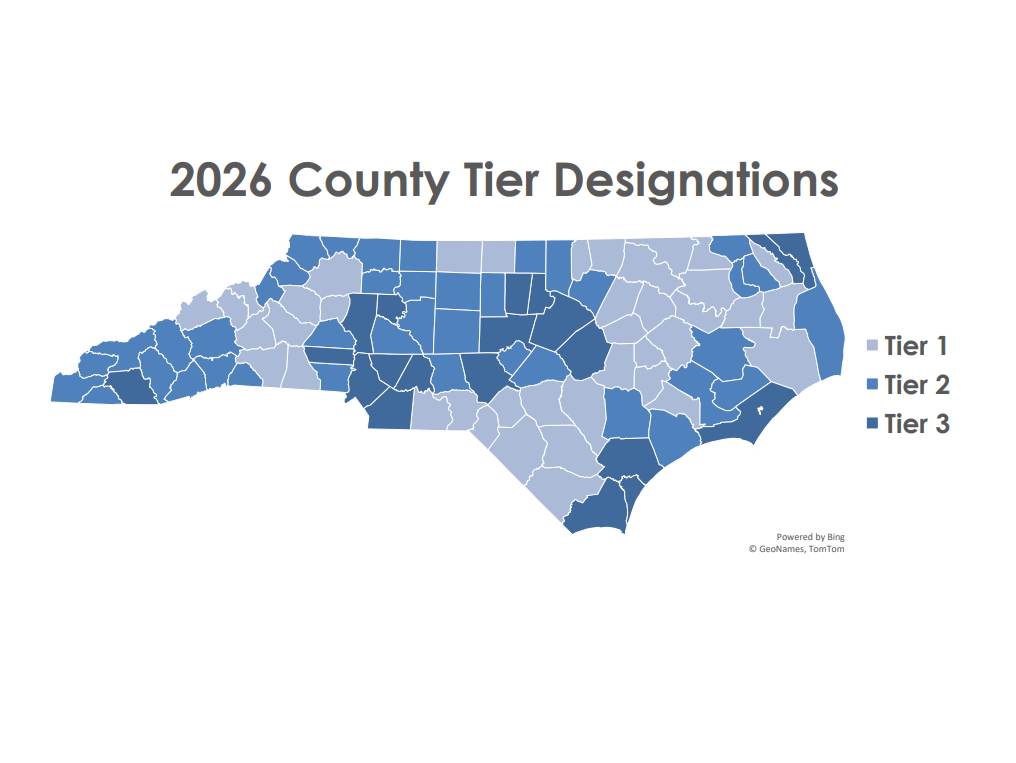
New county tier designations for 2026, released last week, classify some of North Carolina’s western counties as more economically distressed than the previous year, due in part to the impacts of Hurricane Helene.
County tier designations, which have been in place since 2007, use a three-level system to determine economic needs and state funding levels. Certain tier designations may qualify counties for participation in grant programs or for more state financial support.
 Sign up for the EdDaily to start each weekday with the top education news.
How tiers are calculated
The three tiers are Tier 1, Tier 2, and Tier 3, ranging from most economically distressed to least economically distressed. Counties are ranked relative to each other, meaning there will always be a set number of counties in each tier:
- Tier 1 counties have an economic distress rank of 1-40 (most economically distressed).
- Tier 2 counties have an economic distress rank of 41-80 (more economically distressed).
- Tier 3 counties have an economic distress rank of 81-100 (least economically distressed).
Four equally weighted factors are used to calculate the tier rankings:
- Average unemployment rate,
- Median household income,
- Percentage growth in population, and
- Adjusted property tax base per capita.
The system is enshrined in state law, which also mandates a report be sent annually to legislative committees for their use in allocating state funding to promote economic growth. See the 2026 report here.
What do the tiers mean for counties?
Based on the tier of a given county, it might qualify for additional state financial support and grant programs. According to the North Carolina Department of Commerce website, state agencies and “even private-sector or nonprofit organizations choose to adopt the Tiers system as guidance for determining eligibility requirements for a particular program.”
There is no centralized list of state programs that incorporate the system, according to the website, but examples include:
- The One North Carolina Fund, a small business program — the local government funding match requirement depends on the county’s tier: $1 for every $3 in state funds in a Tier 1; $1 for every $2 in state funds in Tier 2; $1 for every $1 in state funds in Tier 3.
- The Community Development Block Grant exempts the 25 most distressed counties from a local match requirement.
- The Job Development and Investment Grant gives different percentages of grant awards to companies in differently tiered counties — 75% in Tier 3, 90% in Tier 2, and 100% in Tier 1.
See more information here.
Which counties are changing tiers?
According to the report from the North Carolina Department of Commerce, 18 counties will change tiers in 2026. Beaufort County, one of the counties moving to a less-distressed tier, owes its move to a 30-position improvement in its unemployment rate rank. Meanwhile, Buncombe County, which was hit hard by Hurricane Helene, had its unemployment rank decline by 70 positions and will be moved from Tier 3 to Tier 2.
Other counties classified as less economically distressed compared to the previous rankings include Camden, Davie, Graham, Macon, Montgomery, Randolph, Stanly, and Surry.
Other counties classified as more distressed compared to the previous rankings include Burke, Granville, Haywood, Henderson, Jones, Madison, Pasquotank, and Yancey.
See detailed ranks and a breakdown of metrics in the full report. See historical county tier designations here.
According to the report, Hurricane Helene led to a rise in unemployment in western North Carolina counties, “impacting not only their rankings but other counties’ rankings across the state.”
The report also notes that the fall 2025 federal government shutdown impacted unemployment data reporting.
Questions about the county tier designation system
In February 2025, an assessment of the county distress rankings was released, funded by the North Carolina Collaboratory and conducted by the ncIMPACT Initiative and NCGrowth “to provide background on the current system, interview a small group of stakeholders on their perceptions, and compare tiers with other models.”
More recently, Carolina Public Press reported that the designation system, intended to help economically distressed counties, often does the “exact opposite.”
According to the North Carolina Department of Commerce website, the tier designation system has been largely unchanged since 2019. That year, adjustments for counties with small populations and, in some cases, high poverty rates, were removed, and the requirement that any county given a Tier 1 designation must retain that designation for at least one additional year was eliminated.
The county rankings are now determined by the four equally weighted factors, consistently used since at least 2007, the website says.
Recommendations to reform the system include expanding the metrics used to calculate tier designations, localizing designations at a more granular level than by county, and using the designations as a guide for economic assistance rather than a mandate.
Details by county
Below, find the details taken directly from the Department of Commerce report explaining the metrics of each county that will change tiers in 2026.
Beaufort County
For 2026, Beaufort County is shifting from Tier One to Tier Two. The county’s economic distress rank improved to #43 (from #31 in 2025). The main factor in the county’s shift to Tier Two is a 30 position improvement in unemployment rate rank.
Buncombe County
For 2026, Buncombe County is shifting from Tier Three to Tier Two. The county’s economic distress rank weakened to #53 (from #86 in 2025). The county unemployment rate rank declined by 70 positions and its population growth rank declined 13 positions.
Burke County
For 2026, Burke County is shifting from Tier Two to Tier One. The county’s economic distress rank weakened to #29 (from #44 in 2025). Despite the county adjusted property tax base per capita rank improving 26 positions, its unemployment rate rank declined by 27 positions, its median household income rank declined 22 positions, and its population growth rank declined 16 positions.
Camden County
For 2026, Camden County is shifting from Tier Two to Tier Three. The county’s economic distress rank improved to #90 (from #79 in 2025). The county adjusted property tax base per capita rank improved 17 positions and its unemployment rate rank improved by 17 positions.
Davie County
For 2026, Davie County is shifting from Tier Two to Tier Three. The county’s economic distress rank improved to #82 (from #74 in 2025). The main factor in Davie’s shift to Tier Three is a 12 position improvement in median household income rank.
Graham County
For 2026, Graham County is shifting from Tier One to Tier Two. The county’s economic distress rank improved to #47 (from #23 in 2025). The county unemployment rate rank improved 52 positions and its adjusted property tax base per capita rank improved by 19 positions.
Granville County
For 2026, Granville County is shifting from Tier Three to Tier Two. The county’s economic distress rank weakened to #49 (from #81 in 2025). The county adjusted property tax base per capita rank declined 39 positions, its population growth rank declined by 22 positions, and its unemployment rate rank declined 19 positions.
Haywood County
For 2026, Haywood County is shifting from Tier Three to Tier Two. The county’s economic distress rank weakened to #56 (from #83 in 2025). The county unemployment rate rank declined 45 positions and its population growth rank declined by 28 positions.
Henderson County
For 2026, Henderson County is shifting from Tier Three to Tier Two. The county’s economic distress rank weakened to #78 (from #85 in 2025). Despite the county adjusted property tax base per capita rank improving 16 positions, its unemployment rate rank declined by 28 positions and its median household income rank declined 11 positions.
Jones County
For 2026, Jones County is shifting from Tier Two to Tier One. The county’s economic distress rank weakened to #34 (from #58 in 2025). Despite the county population growth rank improving 23 positions, its unemployment rate rank declined by 52 positions and its median household income rank declined 20 positions.
Macon County
For 2026, Macon County is shifting from Tier Two to Tier Three. The county’s economic distress rank improved to #81 (from #73 in 2025). The county median household income rank improved 12 positions and its population growth rank improved by 8 positions.
Madison County
For 2026, Madison County is shifting from Tier Two to Tier One. The county’s economic distress rank weakened to #37 (from #64 in 2025). Despite the county median household income rank improving 13 positions, its unemployment rate rank declined by 55 positions and its adjusted property tax base per capita rank declined 27 positions.
Montgomery County
For 2026, Montgomery County is shifting from Tier One to Tier Two. The county’s economic distress rank improved to #44 (from #40 in 2025). The main factor in the county’s shift to Tier Two is a 32 position improvement in population growth rank.
Pasquotank County
For 2026, Pasquotank County is shifting from Tier Two to Tier One. The county’s economic distress rank weakened to #36 (from #41 in 2025). Despite the county unemployment rate rank improving 11 positions, its population growth rank declined by 19 positions.
Randolph County
For 2026, Randolph County is shifting from Tier One to Tier Two. The county’s economic distress rank improved to #51 (from #29 in 2025). The county unemployment rate rank improved 27 positions and its adjusted property tax base per capita rank improved by 26 positions.
Stanly County
For 2026, Stanly County is shifting from Tier Two to Tier Three. The county’s economic distress rank improved to #84 (from #69 in 2025). The county median household income rank improved 17 positions, its unemployment rate rank improved by 13 positions, and its population growth rank improved 11 positions.
Surry County
For 2026, Surry County is shifting from Tier One to Tier Two. The county’s economic distress rank improved to #46 (from #34 in 2025). The county median household income rank improved 25 positions and its unemployment rate rank improved by 10 positions.
Yancey County
For 2026, Yancey County is shifting from Tier Two to Tier One. The county’s economic distress rank weakened to #22 (from #45 in 2025). The county unemployment rate rank declined 53 positions and its adjusted property tax base per capita rank declined by 18 positions.

Recommended reading