
North Carolina Education Lottery revenue up, but less money went to schools

In December, a third-party audit was released by the Office of the State Auditor (OSA) that highlights the most up-to-date numbers on North Carolina Education Lottery (NCEL) sales, revenue, and contributions to education in fiscal year 2025.
The audit showed that, despite increased lottery revenue, there was a decrease in net revenue transferred for education purposes from FY 2024 to FY 2025.
In FY 2024, the NCEL reported $5.4 billion in total revenue, with $1.07 billion of that going into the North Carolina Education Lottery Fund, which was then allocated to various education programs. The remainder goes to the costs of operating the lottery. The largest expense category is prize payouts, which took up about about 70% of the lottery’s total revenue in FY 2024.
In FY 2025, total revenue increased to $6.6 billion, but the NCEL’s contribution to education slightly lowered to $1.05 billion.
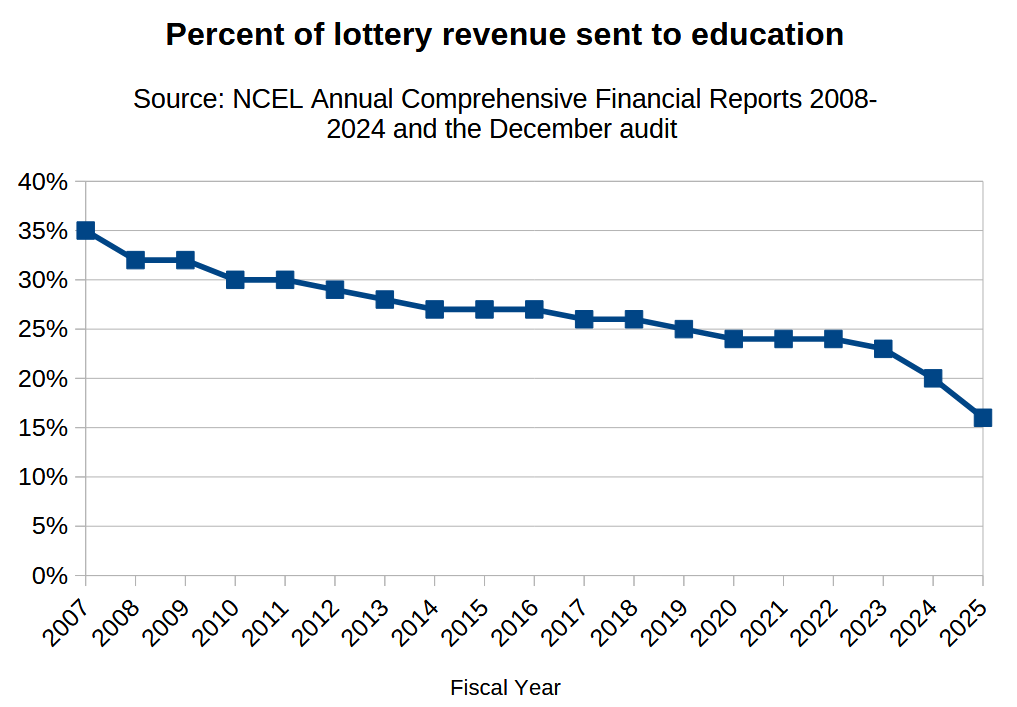
According to a press release, the overall percentage of revenue contributed by the NCEL to public schools has decreased from 23% in FY 2023, to 20% FY 2024, to 16% in FY 2025.
 Sign up for the EdWeekly, a Friday roundup of the most important education news of the week.
The legislation that governs the lottery has a guideline that says 38% of the total annual revenues of the lottery should go to education, “to the extent practicable.” But the share of NCEL revenue going to education has been declining for years.
State Auditor Dave Boliek spoke to NCEL leadership before the publication of the audit, according to the press release. OSA has also launched a subsequent performance audit of the Education Lottery, which is the first such audit since 2008.
“North Carolinians have a reasonable expectation that if the Education Lottery’s ticket sales go up, money going toward our public schools would increase as well. At first glance, these numbers raise a lot of questions. Over the last three years, total revenues have increased by a total of over $3 billion, while contributions to public education have been flat,” Boliek said.
Low jackpots drove lower participation in the lottery
NCEL leadership were given an opportunity to provide commentary on the audit by OSA, and a document with that commentary provides two “independent factors” that led to the results.
One, leadership said, was a downturn in national, multistate draw games such as Powerball and Mega Millions. Last year, jackpots were abnormally low, leading to lower participation and lower sales, the document said.
The document called the jackpot levels “unusual, almost unprecedented.”
Mega Millions and Powerball both use a progressive jackpot. A progressive jackpot — or rolling jackpot, as it’s also called — increases every time there’s a drawing without a winner. When someone wins the jackpot, the prize resets to its starting value.
If there is a steady stream of winners, the jackpot may never reach the heights necessary to drive expected sales.
“When jackpots reach certain levels, such as $1 billion dollars, the level of interest from consumers soars, ticket sales increase, and profits from those sales rise accordingly,” the document said.
Between Mega Millions and Powerball, there were only two drawings that exceeded $800 million in FY 2025, compared to six in FY 2024, according to the document.
An ‘unexpected downturn’ in traditional games
The second factor was an “unexpected downturn” in traditional, higher-margin games. Meanwhile, there was the rise of Digital Instant games, which made up nearly 40% of the lottery’s overall product mix in FY 2025, according to the document. A chart provided by NCEL shows payouts for Digital Instants, introduced for the first time in FY 2024, are the highest among games offered.
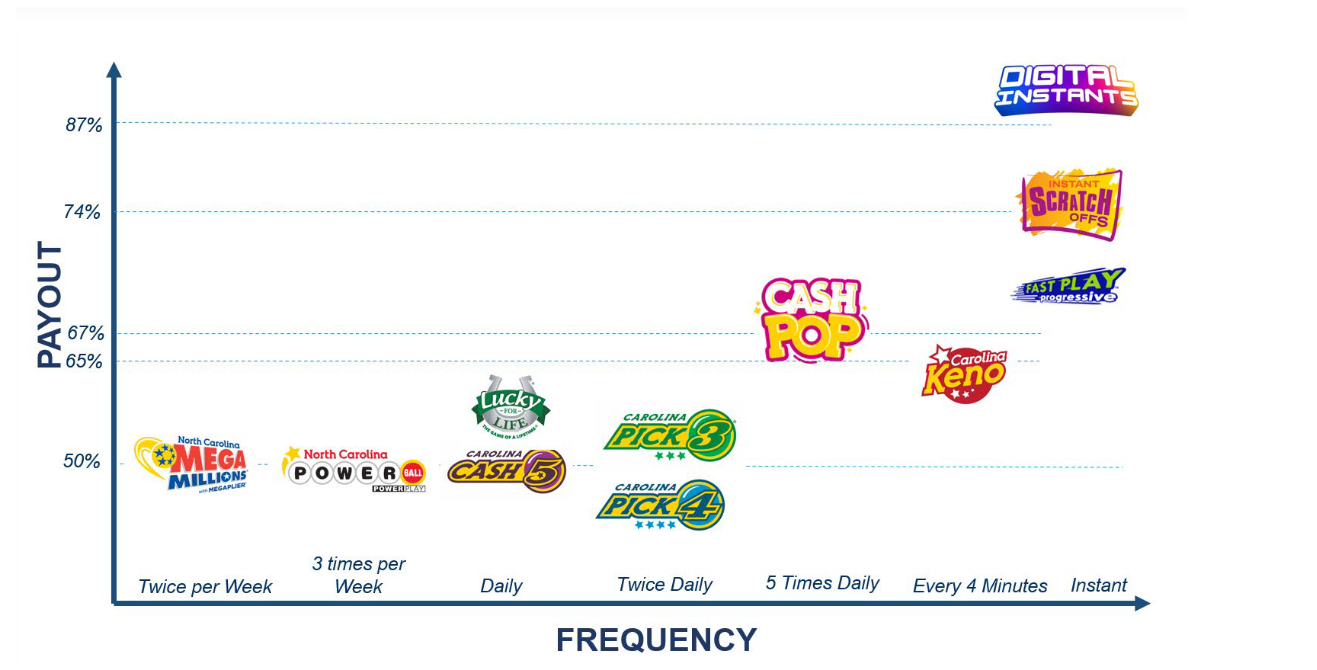
Digital Instants brought more money into the NCEL due to their popularity. But the higher payouts required for Digital Instants also led to more money going out of the NCEL, resulting in a lower net revenue that could be sent to education.
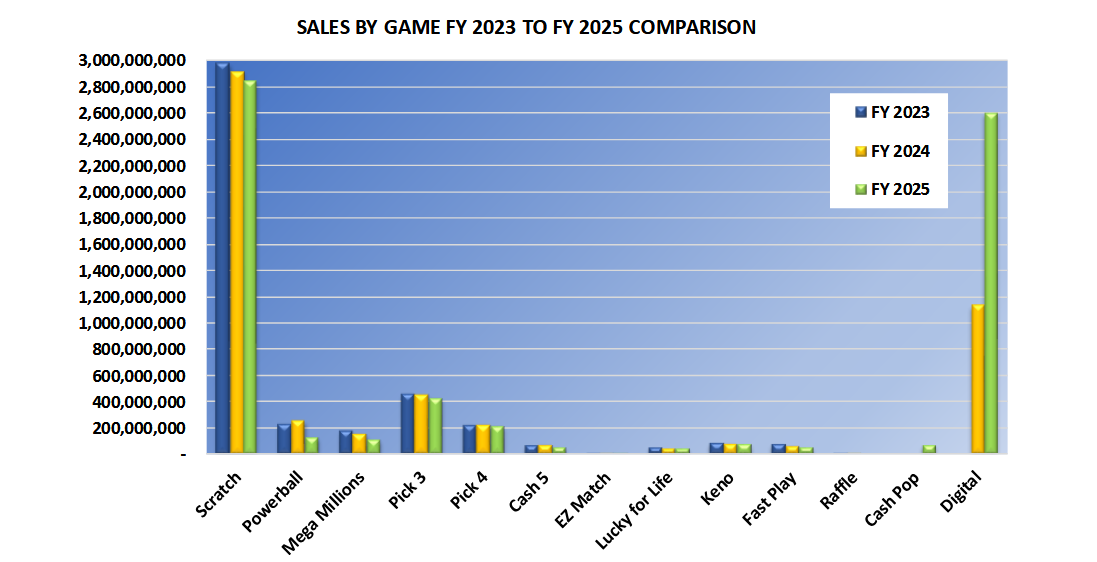
A chart from the OSA audit shows the popularity of Digital Instant games, with sales nearly rivaling Scratch games in FY 2025.
The increased lottery revenue and decreased contribution to education come as the NCEL is competing with other ways to gamble, such as expanding sports betting and prediction markets.
A breakdown of the lottery money sent to education
Lottery funds have been used in different ways since the lottery’s first scratch-off tickets were sold in 2006, as EdNC has previously reported.
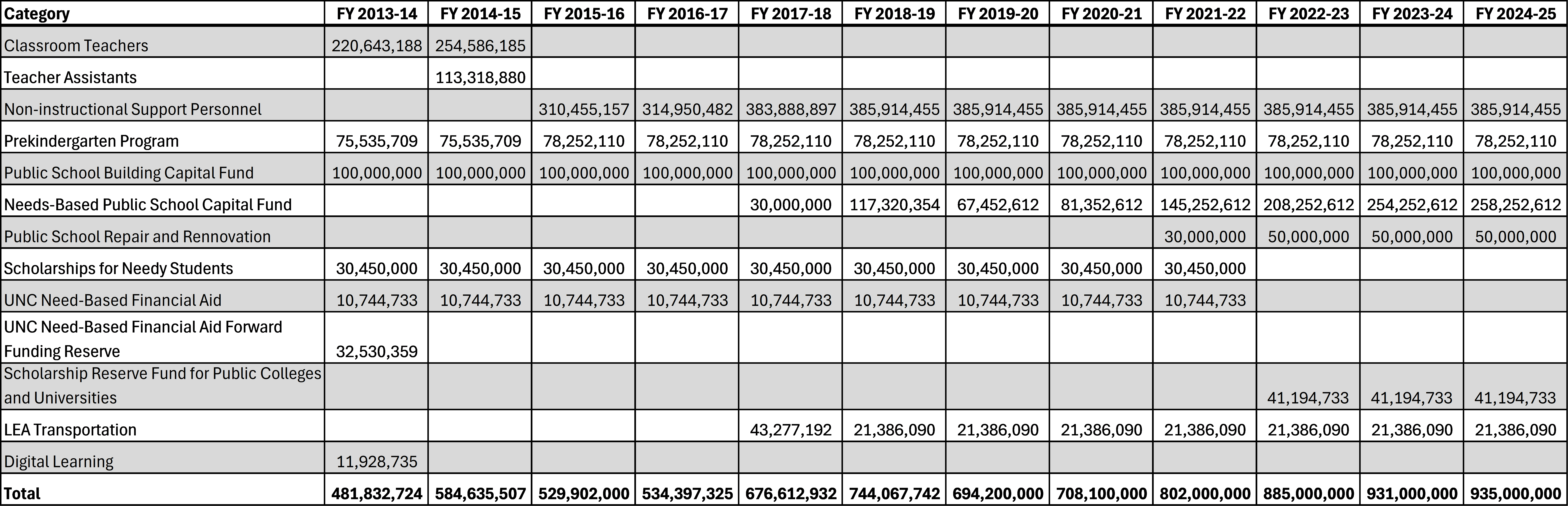
The General Assembly allocates lottery funds as part of its biannual budget process. The table below, previously compiled by EdNC, shows the change over the last decade in where lottery money was sent. Notable contributions include the funding of non-instruction support personnel, like substitute teachers, which lottery funds took over in FY 2015. Another is the steadily increasing funding to the Needs-Based Public School Capital Fund (NBPSCF).
EdNC previously reported on a Hyde County construction project funded by the NBPSCF. In December 2025, it was announced that 10 school districts across the state will receive $392 million in grants for school construction and renovation projects funded by the NBPSCF.
The General Assembly did not pass a new comprehensive budget according to its normal schedule last year. However, lottery allocations were included in a mini-budget that funded essential parts of the state government. Below, see the allocations for FY 2025 and FY 2026.
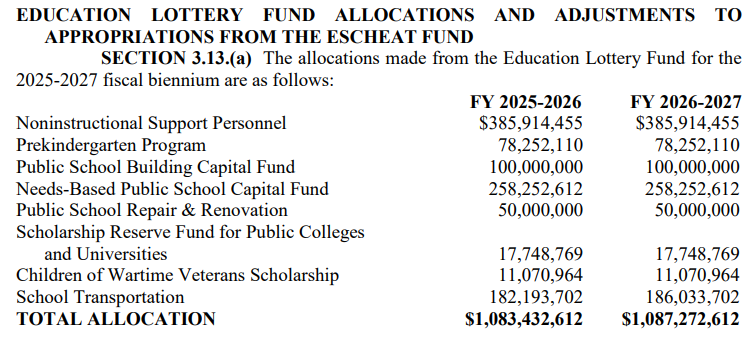
The mini-budget lottery allocations covered cuts made elsewhere. The allocation of more than $180 million for each year for school transportation was a nearly nine-fold increase in funding since FY 2024, when the amount was approximately $21.4 million. That increase covered a roughly $160 million cut in both years of the biennium to school transportation from the Department of Public Instruction’s (DPI) State Public School Fund.
The Children of Wartime Veterans Scholarship, which awards money for the children of veterans to attend North Carolina universities and community colleges, was also allocated lottery funds for the first time.
What now?
The NCEL’s annual contribution does not make up a large percentage of public school funding in North Carolina. DPI put the FY 2024 proportion at 3.5%, though that figure excluded school construction spending, which made up a little over half of the lottery’s contribution.
Therefore, a small decrease in lottery funding might not have a wide impact on education. Nevertheless, in response to the biannual third-party audit’s findings, a subsequent performance audit ordered by Boliek had already been underway for three months in December 2025.
“These numbers led to the initiation of a performance audit designed to take a deep dive into all aspects of the Education Lottery’s finances and operations,” Boliek said. “North Carolinians deserve answers to some tough questions so that we all have a better understanding of the return public schools are getting from the Education Lottery.”