
A new Department of Public Instruction (DPI) report says that 100% of traditional public school districts currently have a 1-to-1 digital device-to-student ratio, though many districts are struggling to replace old or damaged devices due to a lack of funding.
Dr. Ashley McBride, a digital learning initiative consultant at DPI, presented the Statewide Trends in Student Digital Learning Access report at the State Board of Education meeting on Wednesday.
 Sign up for the EdDaily to start each weekday with the top education news.
The report compiles data on students’ access to digital devices in and out of school, as well as their out-of-school internet access, from 115 school districts and 239 charter, lab, and regional schools. Among those 239 nontraditional schools, 84% had a 1-to-1 digital device-to-student ratio.
The report says that in total, these public school units had 1,190,045 digital devices available for students in 2024-25. Chrome devices make up 90.3% of this fleet; 8.7% were Windows devices, and Apple devices made up 1%.
Students can take less than half of these devices home, as 56% of them must stay on school campuses.
“Together, these findings demonstrate that North Carolina continues to rely heavily on school-issued, portable devices to support both in-school instruction and extended learning opportunities beyond the school day,” the report says.
The report also included findings from a survey on out-of-school devices with responses from families representing 55,082 students.
In this sample, 42% of families said their student uses a school-provided device at home, while a third said their student uses a device owned by the family. Around one in five families reported that their student has access to both family-owned and school-provided devices at home. However, 4% of families reported their student does not have access to a digital device at home.

Families who did not have devices at home said they were too expensive, they chose not to purchase one, or the devices they owned were broken, damaged, or outdated, according to the report.
A survey with 36,365 respondent families found that 93% had consistent and adequate internet access for their students at home. Families with limited or no access to the internet at home said that was due to high costs or the internet connection not being dependable.
Still, those families described several alternatives they use to ensure their students can access the internet, including using the internet at public libraries, hot spots, other people’s homes, school parking lots, among other options.
“My rural county, still one third of it, does not have internet capability. And after Helene, many parts of our community do not have Wi-Fi coverage, nor do they have cell coverage. That’s typical in the western part of the state,” said Board member John Blackburn, who represents the state’s Northwest region. “I just want to remind everybody that there are still points of darkness in the state of North Carolina.”
Beckie Spears, the 2024 Wells Fargo Principal of the Year, said that her rural elementary school had one Chromebook cart per grade level prior to 2020. Now, there’s one in every classroom, she said, but the devices are aging and the district doesn’t “have any ways to replace them.”
“The reality is we have stretched every resource as far as we can, and in Tier 1 counties and Tier 2 counties where local funds are not accessible, this is a real and urgent problem that needs attention from our legislators,” Spears said.
The report says that these findings highlight the importance of school-provided digital devices for students. But since pandemic-era funding from the federal Elementary and Secondary School Emergency Relief Fund (ESSER) and the Emergency Connectivity Funds (ECF) has ended, many schools are struggling to sustain student device programs.
McBride’s presentation said 88 out of the state’s traditional school districts — nearly 77% — as well as 97 charter, lab, and regional schools, don’t have dedicated funds to refresh students’ school-provided digital devices.
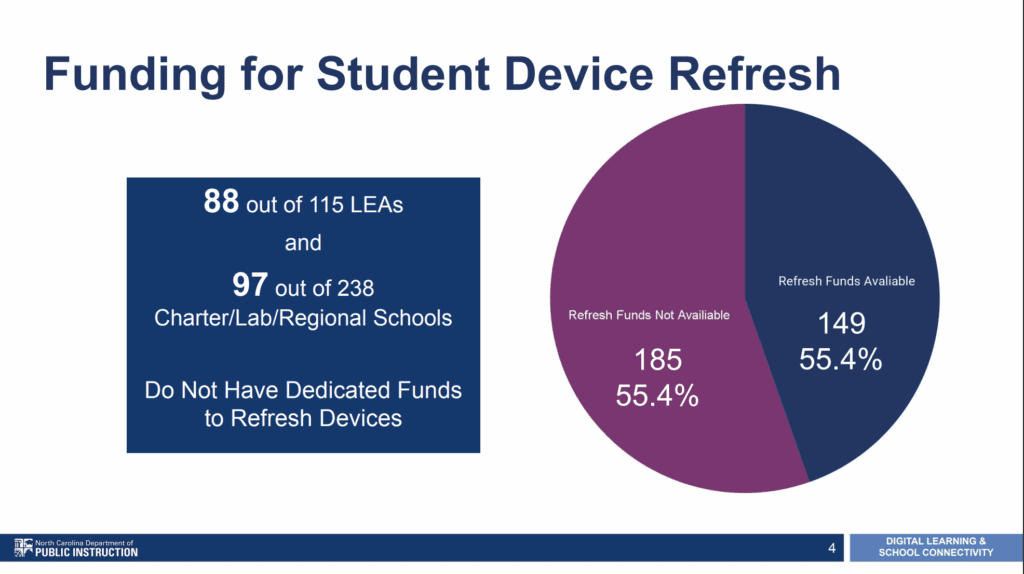
“Large portions of the current device fleet have aged beyond expected lifespans, resulting in higher failure rates, declining performance, and reduced reliability for both classroom and at home use,” the report says.
The report says some schools have limited or stopped take-home access for their device fleets because they don’t have inventory to replace them.
According to McBride, prior to ESSER funding, only 16 school districts had a 1-to-1 digital device-to-student ratio.
DPI recommends that the state allocate recurring funding to support student device programs to reduce reliance on short-term federal funding, according to the report. This legislative session, DPI requested $152.6 million in recurring funds for a 1-to-1 device refresh over a four-year period.
The report also recommends providing statewide guidance on devices’ life cycle management, including cost considerations and multiyear budgeting strategies. The department also recommends using data systems to track devices’ age, availability, and take-home capacity, and “exploring how to improve parental participation in reporting on home connectivity and device access.”

Recommended reading