
Portrait of a Graduate aligns with what employers look for, analysis says

A new analysis has found that skills identified through the Portrait of a Graduate (POG) initiative are key to future employers in North Carolina.
The POG initiative began in 2022. It is led by the N.C Department of Public Instruction (DPI) and defines the skills and mindsets students need for success after high school. It uses seven competency areas that students should have by the time they graduate, including adaptability, collaboration, communication, critical thinking, empathy, a learner’s mindset, and personal responsibility.
The competency areas are also considered durable skills. Skills are durable when they can hold value regardless of how the labor market changes, and these skills are also widely applicable to different occupations.
 Sign up for the EdDaily to start each weekday with the top education news.
The N.C. Department of Commerce’s Labor and Economic Analysis Division (LEAD) conducted an analysis of POG data and compared it to skills an employer needs within the state. Researchers confirmed that the skills were at least “somewhat important” across all occupations. Educators said they aim to use the results to plan learning objectives for students.
N.C. Commerce Secretary Machelle Baker Sanders said that students and future employers succeed when the education and workforce development systems are aligned.
“As we celebrate the ‘Year of Public Schools,’ this innovative research highlights the fact that increasing job readiness and career awareness among young people helps North Carolina respond to the needs of businesses and remain ‘First in Talent,’” Sanders said.
LEAD researchers used government labor statistics data to quantify durable skills. They then used the information to measure how useful they are in different professions across the state.
According to DPI, POG scores were calculated based on the degree of importance. Each occupation is assigned an importance score for skills and abilities, which range from “Not Important” (1) to “Extremely Important” (5). To calculate the importance of a durable skill, researchers calculated a composite score using data from the national Occupational Information Network (O*NET) about skills and abilities that influence job prospects.
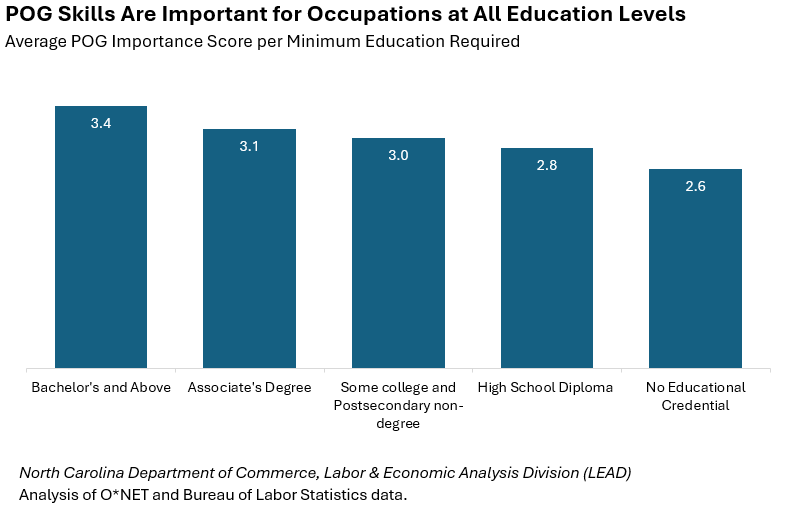
For different education level requirements, ranging from no credentials to bachelor’s degree or higher, each POG score was about three. This means the durable skills included in the POG were important to jobs with those requirements, researchers said.
According to the analysis, LEAD researchers put the occupations into three groups: somewhat important (POG score < 2.5), important (POG score ≥2.5 to <3.5), and very important (POG score ≥3.5) while assessing wage and growth data. The more money and growth potential an occupation had, the higher the POG scores. Meaning, the more important the skills were, the more money and better career trajectory.
LEAD researchers said the overall POG scores ranged from 2.0 to 3.9, indicating that no occupation ranked the POG durable skills as “Not Important.”
North Carolina has made plans to use the data to build connections between students and the workforce. DPI released a set of performance tasks that will be implemented in classrooms during the upcoming school year. The tasks are learning experiences that incorporate the portrait’s durable skills while aligning with the N.C. Standard Course of Study. Examples include activities related to civic engagement and career exploration.
DPI has also collaborated with the N.C. Chamber Foundation on a K-12 Talent Pipeline Toolkit.
“I want every North Carolina student to leave our public schools prepared to enter the workforce, join the military, or pursue higher education,” State Superintendent Catherine Truitt said. “We must integrate durable skills into classroom curricula so that our graduates are equipped to succeed in family-sustaining jobs that are essential to our state’s economy.”
Share this story
- “We must integrate durable skills into classroom curricula so that our graduates are equipped to succeed in family-sustaining jobs that are essential to our state’s economy.” Read more about what durable skills are and how they impact NC students' futures.
- Research shows that employers value the skills identified in NCDPI's Portrait of a Graduate.