National report details trends for ‘Some College, No Credential’ students


According to a new report from the National Student Clearinghouse Research Center, there are nearly 1.2 million people in North Carolina that attended college but stopped out before completing their degrees — known as “Some College, No Credential” students (SCNCs).
The number of SCNCs under 65 in North Carolina increased by about 15,000 since 2024 — about a 1.5% increase. Meanwhile, the increase was 2.2% across the United States.
“Today, nearly 43.1 million people are stopped out of college without a credential. Of these, 37.6 million are working age adults under age 65,” the report says. “As states look to increase the skills of their labor forces and institutions confront changing demographic realities, re-engaging with these Some College, No Credential (SCNC) individuals has never been more crucial.”
 Sign up for Awake58, our newsletter on all things community college.
According to the report, all states saw increases in the size of their SCNC populations, while 42 states — including North Carolina — and the District of Columbia saw increases in their SCNC reenrollment in 2023-24 compared to the previous year. In North Carolina, the reenrollment rate was 2.7%, the same as the national rate.
Students with at least two years of full-time equivalent (FTE) enrollment prior to stopping out, or “potential completers,” made up just 7.1% of SCNCs under the age of 65 in North Carolina.
The report says that “recent stopouts” — people who were last enrolled four to five academic terms prior to the start of the current academic year — made up 5.3% of SCNCs under 65 in the state.
Potential completers and recent stopouts are more likely to reengage with higher education, the report says.
Related reads



North Carolina’s number of SCNC’s under 65 compared to its total undergraduate enrollment is similar to the country at large. The state’s proportions of recent stopouts and potential completers is also comparable to national rates.
According to the report, community colleges and online institutions “stand out for the outsized role they play in SCNC dynamics.”
“Community colleges are both the major source of stopout and the primary destination for returning SCNC students,” the report says. “Primarily online institutions account for a disproportionately high share of re-enrollees compared to the share of SCNC individuals who last attended these institutions.”
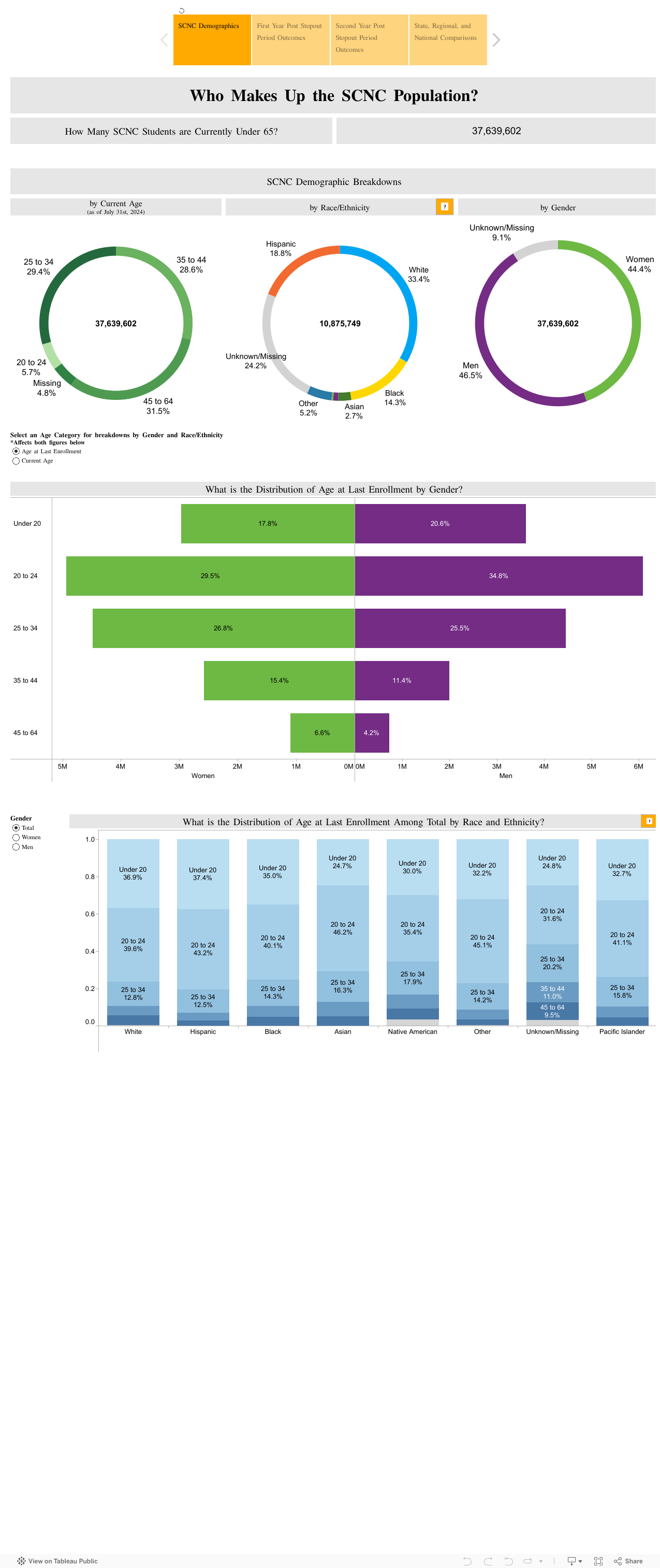
Race/ethnicity and gender also affect SCNC rates. White and Asian students made up less of the SCNC population compared to the undergraduate population overall, but returned to earn credentials at higher rates than those of other race/ethnicity backgrounds.
The SCNC population was also more male than the overall undergraduate population, meaning female students are more likely to complete their degrees.
These disparities have been observed in recent years.
However, the report says, despite persistent disparities, all groups saw some gains in reenrollment, perseverance, or credential earning over the past three years.
Below, find an interactive dashboard provided along with the report that shows overall demographics, post-stopout outcomes, and comparisons between different states regions.