
A Robeson County preacher is on a quest to ban books. The school board says no way
This story was originally published by the Border Belt Independent.
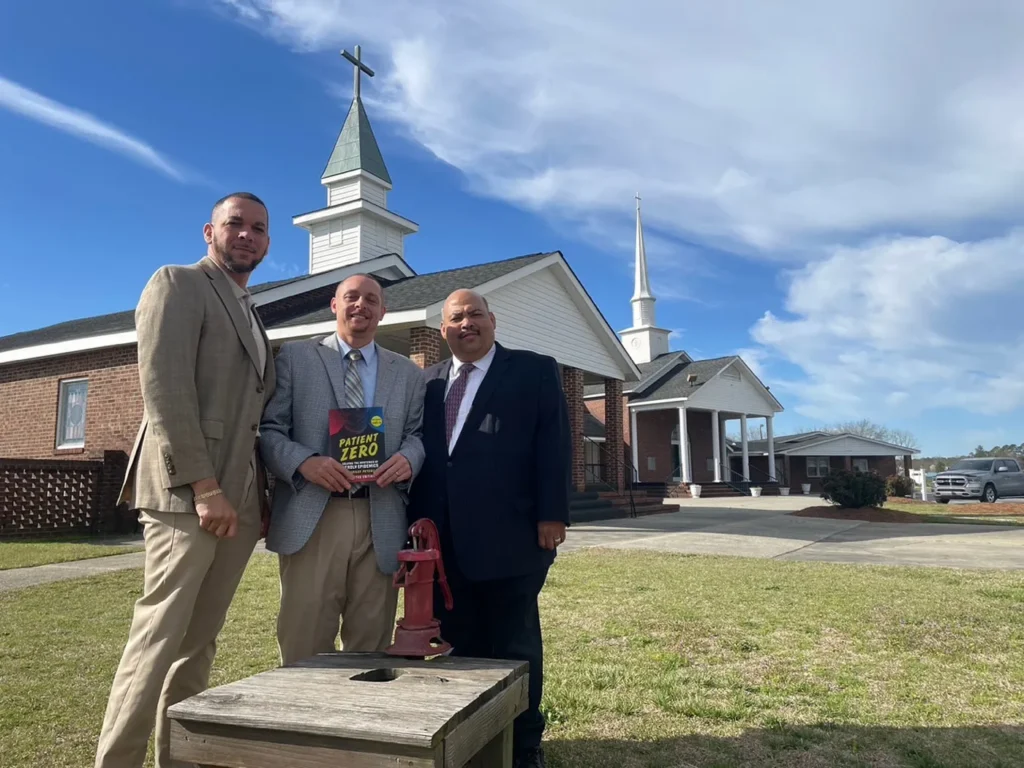
The Rev. Nicholas McNeill, a Southern Baptist, said he was angry when he found out his third-grade daughter read a book about Islam at the Robeson County school she attends.
“I want them just to teach my child reading, writing and math,” McNeill said, “not undo what I’m doing at home.”
The Robeson County Board of Education denied McNeill’s request in November to remove “Nasreen’s Secret School,” a book about a girl who attends a school for young women in Afghanistan.
When McNeill appealed the decision, the board denied his request again.
That’s when McNeill, who once taught Exceptional Children courses for high school students in Robeson County and now serves as pastor at Zion Hill Baptist Church in Rennert, began to research other books being read by Robeson County students. He was particularly concerned, he said, about “Patient Zero,” a story about epidemics and pandemics that includes a chapter about AIDS and addresses LGBTQ issues.
In February, McNeill began hosting community meetings to inform parents and grandparents about the books their students were reading. Hundreds have attended.
Now McNeill says he wants Robeson to stop using the EL Education K-8 Language Arts Curriculum, which calls for interactive study and critical thinking. “It’s no longer just presenting information,” he said. “Now it’s an agenda.”
Book bans have become a hot topic across the country in recent years, with parents pleading with school boards to remove books they say are offensive or inappropriate for children.
Between July 2021 and June 2022, schools in 32 states banned 2,532 books, affecting nearly 4 million students, according to a September report by PEN America. About 40% of the books contained LGBTQ themes.
Critics of book bans, however, say censorship is harmful to students as they navigate an ever-changing world.
During a Robeson County school board meeting Thursday, some district staff members said state standards require schools to teach children inclusivity and introduce them to different cultures and perspectives.
“We’re not trying to indoctrinate anybody with anything,” Superintendent Freddie Williamson said during the meeting. “We’re teaching the curriculum, trying to improve the teaching and learning of our students.”
The Robeson County school district, which serves about 20,000 students in a rural swath of southeastern North Carolina, has been designated as low performing for seven of the last eight years, said Windy Dorsey-Carr, assistant superintendent of curriculum, instruction and accountability.
This year, Robeson has the only school in North Carolina’s Innovative School District, which was created by the state legislature in 2016 to serve low-performing schools. In 2018, the local Board of Education turned Southside Ashpole Elementary School in Rowland over to the state.
In August, Robeson County schools became the third district in the state to adopt the EL Education K-8 Language Arts Curriculum. The other districts are Mecklenburg and Wake, home to the state’s largest cities.
Since the implementation of the curriculum – which Dorsey-Carr called the nation’s “gold standard” – about 1,300 Robeson County students have increased their school performance to at or above grade level, and about 80% of schools have made growth, she said.
“We’ve really just had a few months, and we’ve seen a tremendous amount of improvement,” Dorsey-Carr said.
But some parents, like McNeill, have said they are concerned about some of the lesson prompts. For example, in third grade, the curriculum prompts students to discuss gender stereotypes while reading “Peter Pan.”
“To teach our children that you don’t have to be motherly, you don’t have to be maternal, that you can be more manly, that you can be anything other than what God made you, I can’t allow that,” said McNeill, adding that he views his wife, who has a master’s degree in education, as an equal.
McNeill said he is also concerned about critical race theory, which he calls reverse discrimination. Known as CRT, critical race theory is a scholarly framework that says systemic racism is and has been a part of society in the United States.
“We’re Native Americans, and we know what it means to be overlooked or to be discriminated against here in Robeson County,” McNeill said. “But I think the answer is not to turn around and do what they’ve done to us.”
School staff said at the Thursday meeting they are not teaching children CRT or LGBTQ content.
“We have 70 instructional days left,” Williamson said at the meeting. “We cannot spend time trying to defend something that’s not true. It’s not fair to our kids.”
McNeill said he got a religious exemption for his daughter so she will not read “Nasreen’s Secret School,” and he has helped other families do the same. He said he will take his daughter out of the Robeson County district if the school board does not switch to a different curriculum.
“We’re as conservative as you get,” McNeill said. “This may be a wonderful curriculum – I don’t think it is – but it’s obviously not working here.”
District staff say they hope parents will eventually accept the books and the curriculum. In three to five years, Dorsey-Carr said, the goal is for Robeson to no longer be a low-performing district.
“We must change,” she said.