School nutrition programs have long operated on thin margins, but budget pressures are intensifying. Faced with federal reimbursement rates that have not kept pace with increasing costs, compounded by state-mandated increases in wages, school nutrition leaders in North Carolina are raising alarm bells on the financial state of their programs and calling on the state for support.
“We joke oftentimes in the field that we know how to cut a penny eight times,” said Rachel Findley, senior director of the office of school nutrition and auxiliary services at the N.C. Department of Public Instruction (DPI). “But we will be quickly approaching financial insolvency if we don’t receive funding, either federally or state.”
 Sign up for the EdWeekly, a Friday roundup of the most important education news of the week.
School nutrition programs, also called school food authorities (SFAs), operate financially independently of school districts and are expected to be self-sustaining. These programs primarily rely on per-meal reimbursements from the federal government to cover all costs related to serving meals, including food, staff salaries and benefits, equipment, supplies, and overhead. During the 2025-26 school year, the average federal reimbursement was roughly $4.70 for each free school lunch and $2.70 for each free school breakfast.
But food and labor costs are continuing to rise faster than the incremental annual increases in the federal reimbursement rate, creating an unsustainable financial reality for many school nutrition programs.
According to materials provided to EdNC by the School Nutrition Association of North Carolina (SNA NC), an organization of 12,000 school nutrition workers across the state, roughly 84% of school nutrition programs were “in the red post-pandemic,” accruing a statewide total of $15 million in debt as of 2025.
How are school meals funded? Consider the restaurant analogy
Amy Stanley, school nutrition director in New Hanover County Schools, said the best way to think about the finances of a school nutrition program is to consider them a “restaurant within the school district.”
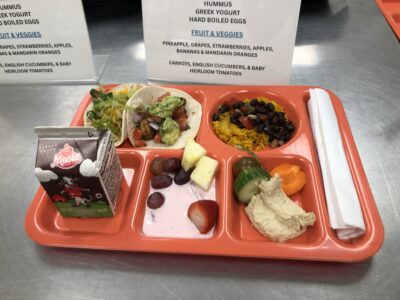
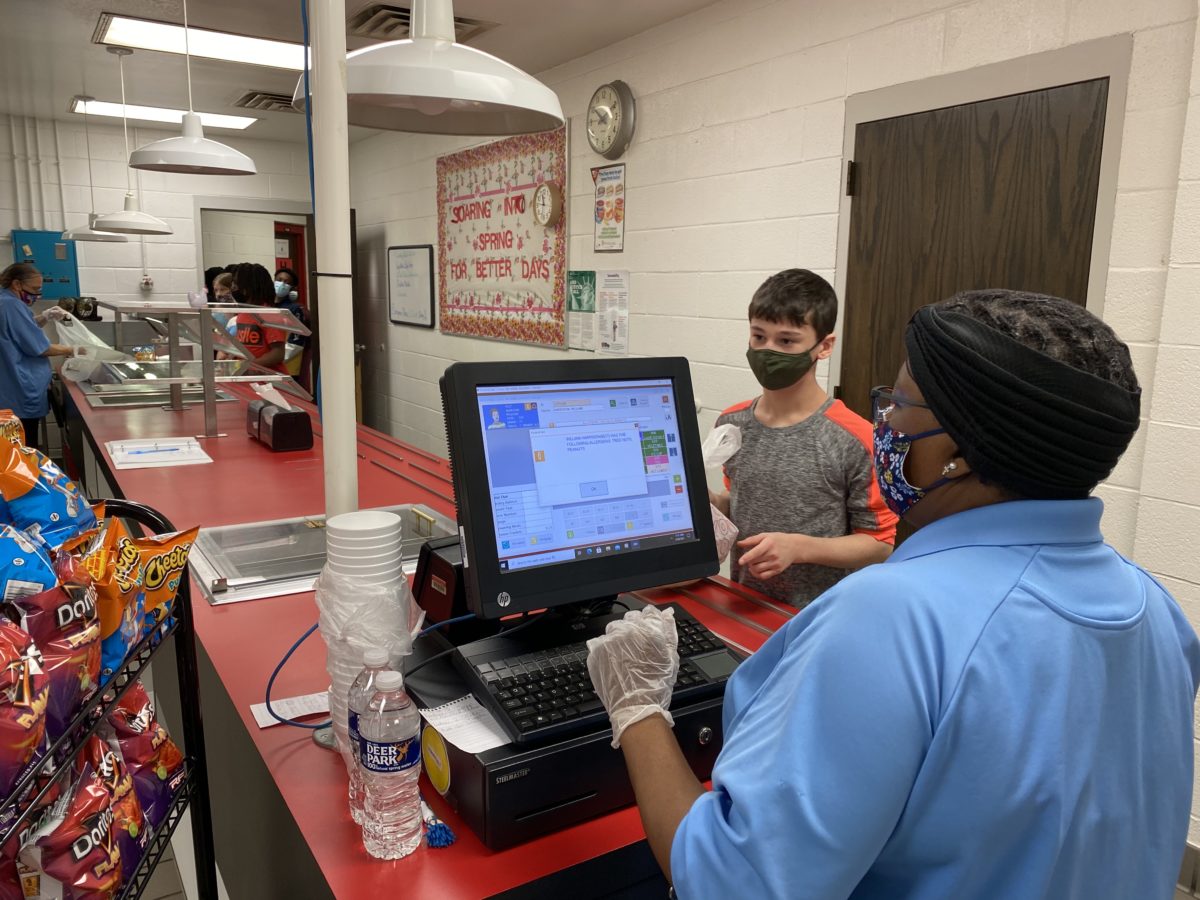
Using that analogy, Stanley’s program operates more than 40 “restaurants” — one in each of the district’s schools — and is solely responsible for the planning, budgeting, purchases, and labor that ensure meals are served to the district’s roughly 25,000 “customers,” or students.
But unlike a typical restaurant, school nutrition programs have to serve meals that meet strict nutrition standards while primarily relying on a federal reimbursement of roughly $4.70 per lunch.
“That has to pay for everything in that space — it pays for the food, it pays for the labor, it pays for the printer paper, it pays for the computers. It depends on the district — it might even pay for the toilet paper in the bathroom,” Findley said.
For a detailed breakdown of how school meals are funded, see this article.
Wage increases create ‘unfunded mandate’
One of the primary drivers of rising costs, Findley said, is labor. In 2021, North Carolina’s state budget increased the minimum wage for noncertified school personnel to $15 per hour, starting in fiscal year 2022-23.
Those personnel, which include school nutrition staff, have their base wages set by the state legislature. However, the state budget does not include funding for school nutrition personnel salaries and benefits.
Findley said state leaders often mistakenly think the legislature funds school nutrition personnel through the funding allocated for school districts. In reality, school nutrition labor costs are paid primarily by federal meal reimbursements, and the state-mandated increase in minimum wage did not come with additional funding — leaving school nutrition programs with an “unfunded mandate,” Findley said.
Even if school nutrition directors wanted to pay their employees more than $15 an hour — let alone a living wage — school nutrition programs are not funded at the level needed to do so.
“We are primarily funded federally, without much opportunity at the state level to offset our fixed costs. And so when they increase our fixed costs and don’t increase the amount of revenue coming in for our program, we’re setting ourselves up for kind of a perfect storm,” Findley said.
Compounding increased labor costs are the persistent labor shortages and retention challenges many school nutrition programs face. In a national survey of school nutrition programs, more than 88% of program directors cited challenges with staff shortages as their programs often compete with local restaurants for employees.
Findley said some programs have increased minimum wages to $16 or $17 in an attempt to attract workers — wages that are still below a living wage for families, especially considering that most school nutrition employees are only employed for four hours a day, nine months of the year.
According to the News & Observer, the school nutrition program in Wake County Public Schools has doubled spending on staff over the last decade, with minimum wages now set to $17.75 per hour in an effort to improve recruitment.

To address this challenge, SNA NC’s primary legislative request this session is a special provision that would cover the differential of the state-mandated salary increases for noncertified school personnel. According to SNA NC, $3.4 million would cover each 1% increase in school nutrition employee wages. If the state were to increase noncertified school personnel salaries by 3%, for example, then the appropriation would be $10.2 million in recurring funds.
“The increased salary costs, combined with higher food costs and workforce challenges, continue to erode the ability for School Nutrition Programs to remain financially solvent,” reads the SNA NC legislative agenda. “We must have State funding now unlike ever before to support our programs and children.”
The legislative agenda also notes that meal prices would have to be “increased unrealistically” to offset salary costs from the mandated pay increase.
“A radical increase in school meal prices will result in fewer students participating in our programs, further exacerbating not only our program’s financial stability, but also the child hunger problem in North Carolina,” the request reads.
Some states already provide funding for school nutrition personnel salaries or benefits. Georgia, for example, provided $36 million in state funding in fiscal year 2025 to supplement base salaries for full-time school nutrition staff, a $400 manager supplement, and two days of sick leave.
Other financial challenges facing school nutrition programs
Additional budget pressures facing school nutrition programs include increasing costs of food and food delivery, increasing costs to repair and replace aging equipment, and declining participation. When fewer students participate in school meals, federal reimbursements decline, tightening budgets even further.
In Wake County Public Schools, the News & Observer reported that the cost of a chicken sandwich is now $1.15, compared to 38 cents a decade ago, and the price of shipping food has increased to $3.57 per case, compared to $1.12 a decade ago.
In New Hanover County Schools, where Stanley works, participation is declining for two primary reasons — demographic shifts are resulting in smaller kindergarten classes each year, and the program had to resume collecting household meal applications following the expiration of pandemic-era waivers that allowed all meals to be provided for free. On top of that, Stanley said, the program has increasingly had to replace aging equipment.
“Revenues versus expenses is what keeps you up at night,” said Stanley. “Because everything is increasing but the revenue stream.”
Recent federal cuts to the Supplemental Nutrition Assistance Program are expected to further decrease participation in school meals. Children whose families lose access to SNAP will also lose direct certification for free school meals, and it will be more difficult for schools to implement the federal Community Eligibility Provision, which allows low-income schools to offer free meals to all students.
In a recent survey of large districts’ school nutrition programs nationwide, 74% reported concerns about how federal cuts to SNAP and Medicaid will impact school meal administration and participation.
Read more


“We are an essential school supply — and every child should have the benefit of eating a school meal, regardless of demographics,” said Stanley. “We should be supporting the children, and financial support is needed.”

Recommended reading