Family choice, local momentum, state funding streams
Early Bird readers, hello again. Newcomers, welcome! If you were forwarded this email, you can sign up here to receive it every two weeks, and join our conversation on issues facing North Carolina’s young children and those who support them. If you’re already a subscriber, please help us reach more people by sharing this with your friends and co-workers interested in early childhood education.
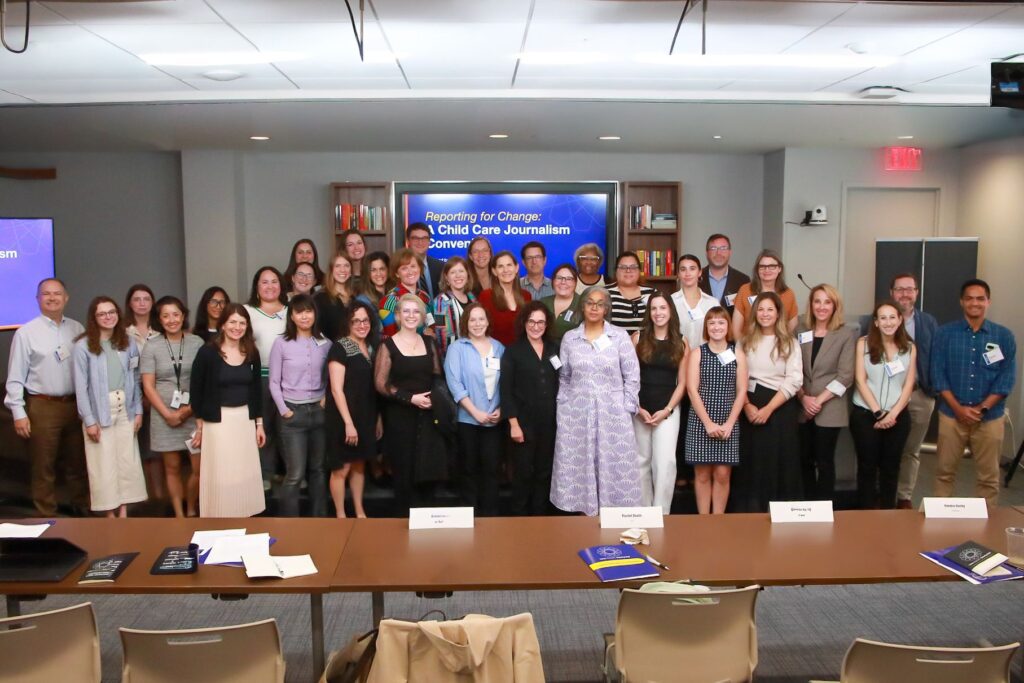
I spent time with child care journalists (see photo above) from across the country at the beginning of this month in Washington, D.C., at a conference hosted by New America’s Better Life Lab and sponsored by the Bainum Family Foundation. It was a breath of fresh air to meet other reporters dedicated to telling stories about the realities facing young children and their families — and to dream about the possibilities of better realities.
Since I’ve been back in North Carolina, I’ve been in Raleigh, Jacksonville, and Rocky Mount in rooms with people discussing challenges and opportunities in early care and education. Katie also attended and wrote about the latest meeting of Gov. Josh Stein’s Task Force on Child Care & Early Education, a room in which state leaders and legislators heard the emotional stories of providers on the brink of closure and parents without options. I’m noticing some common threads in conversations at the local, state, and national level:
- Families want options. The early childhood years are vulnerable for both children and families. People who are extremely familiar with child care and those who are not — and individuals across the ideological spectrum — can agree that family agency is important to protect this fragile and foundational time. Whether that means using a formal child care center or home-based setting, a trusted caregiver, or receiving support to stay home with a child, families deserve to be able to choose what works best for them.
- Without federal movement on child care investment, states are using a range of approaches to securing public and private funding for child care. After New Mexico became the first state to offer universal child care, states are looking for their version of the path forward. In North Carolina, leaders haven’t landed on what that looks like, but members of Stein’s task force are looking to New Mexico, as well as Nebraska, Connecticut, Washington, D.C., Arizona, Iowa, Louisiana, and Montana to learn more about how their child care funding streams operate. North Carolina leaders are interested in private philanthropy and businesses playing a significant role in that funding model.
- Localities are not waiting. In Onslow County, community leaders this month launched the most recent of several local child care task forces across the state to spread awareness and find opportunities for partnership, fundraising, and advocacy. The City of Wilmington passed a resolution backed by nonprofit NC Child on Oct. 7 calling on the state to address child care accessibility and affordability. NC Child said in a Facebook post they are planning to work with more local governments to pass similar measures.
- It all comes down to support for the early childhood workforce. Multiple advocates have told me they think supports for teachers, like expanding the WAGE$ program or allocating funds to cover child care costs for teachers’ children, should be prioritized.
Below, don’t miss our updates on how the Trump administration’s policy changes are impacting early childhood programs serving English learners and Hispanic Serving Institutions, the federal government shutdown, a Durham screening of a documentary on child care heroes, and much more. Thank you for reading and for supporting our youngest learners.

More from EdNC on early childhood
Gov. Stein’s task force hears why child care is an ‘essential service’ for families, economy, and military readiness
At the Oct. 6 meeting of the North Carolina Task Force on Child Care and Early Education, two child care providers were asked what advice they would give to their younger selves or to someone else thinking of opening a...Onslow County leaders launch child care task force with aim to be 'a caring community'
When Elizabeth Thomas came to Jacksonville from Kinston in 1981, she could not find child care for her toddler. It was an overwhelming process that brought her to tears, Thomas said. “And I’m not a crier,” Thomas, a retired educator,...A look at the Trump administration's changes to education policy for English learners, HSIs, and more
At the start of the school year, the U.S. Department of Justice said that it won’t defend Hispanic-Serving Institutions (HSIs) from a recent lawsuit filed by the State of Tennessee and the group Students for Fair Admissions. The suit says...Profiles in Care | Principal Dwayne Johnson and early childhood literacy
EdNC is highlighting the experiences of educators, families, researchers, and advocates with a stake in North Carolina’s early care and learning landscape. These profiles illustrate that care and education are inseparable, especially in a child’s first five years — caregivers...Perspective | The first classroom: What the children taught me
They say every educational journey has a first classroom. Mine was a very small room, a former office, at the end of a long cinderblock hallway, filled with second graders — most of whom were supposed to be third graders....Perspective | Hey Alexa, can you teach empathy?
I have a vivid memory from my first year of teaching. A 4-year-old boy, frustrated that a wooden block would not balance, turned to his friend and said, “Here, you hold it.” Together, they solved the problem. Their faces lit...The big picture for little kids
Legislative Updates
Depending on how long it lasts, the federal government shutdown could impact some federally funded early childhood programs, like Head Start and the Special Supplemental Nutrition Program for Women, Infants, and Children (WIC).
The Child Care and Development Block Grant, the largest source of federal child care funding that gives money to states for child care subsidy, is safe in the short-term because states have funding on hand. The National Association for the Education of Young Children has some helpful basic information on how we got here and what it means for programs.
North Carolina’s Division of Child Development and Early Education (DCDEE) said at the beginning of the month that they were able to continue services for the time being. DCDEE said to reach out to licensing consultants with any questions or concerns.
“While DCDEE is currently operating normally, a shutdown in Washington DC can have far-reaching consequences for North Carolina communities, impacting families of federal employees as well as families that rely on federally funded state and local services and programs,” read a statement from DCDEE Director Candace Witherspoon in the division’s newsletter.
News & Research
-
State Strategies for Sustained Investment in Kids: A Landscape of Dedicated Funding - From Children's Funding Project
-
Why This Vermont Child Care Organization Was Designed to Sunset After a Decade - From zero2eight
-
Getting preemies the help they need - From The Hechinger Report
-
The ‘Silver Bullet’ to Fix Child Care’s Staffing Problem - From EdSurge
-
How Universal Child Care Could Change the Economy - From The New York Times
-
Home Visiting Yearbook - From National Home Visiting Resource Center
-
Oregon May Be the Canary in the Coal Mine for Child Care Cuts - From zero2eight
Taking flight! Opportunities to spread your wings
Documentary screening - From PBS North Carolina
Friday, Nov. 14 at 6 pm | Durham Main Public Library
Screening and panel discussion of documentary, “Make a Circle”
From the organizer: “The film follows a group of courageous childcare providers who are working to transform how society values early childhood education. With a blend of humor, heart and advocacy, the film highlights the stories of three individuals striving to make a difference.”
Webinar for building early childhood apprenticeship programs - From TEACH Early Childhood National Center
Oct. 22, 2025 at 1 pm
From the organizer: “Apprenticeship program development can feel overwhelming. There is always something to consider. One of the most critical components to a successful apprenticeship program is building an invested team. This session will explore not only who should be on your team, but team experiences that shaped program development and implementation. Listen to colleagues as they share how they built a team that was invested in the development of ECE apprenticeship programs.”
Nourishing Connections: How Nutrition Shapes Developing Brains in the Context of Early Childhood Relationships - From North Carolina Infant and Early Childhood Mental Health Association
Oct. 23, 11 am to 1 pm
From the organizer: “Join us as we explore the intersection of early nutrition and brain development and how these early connections, created in the context of supporting family culture, build lasting impacts on early mental and relational health.”
Child Vaccines: Families Have Questions. We Have Answers. - From Zero to Three
Zero to Three, a national nonprofit focused on supporting infants, toddlers, and families, answers common questions about vaccines and provides guidance for early childhood professionals talking to families about vaccines.