NC Collaboratory convenes work group to study weighted student funding. Here is what you need to know

In Section 8.22 of the 2026 Appropriations Act, the North Carolina General Assembly directed the North Carolina Collaboratory’s Office of Learning Research to convene a group of experts to study North Carolina’s potential transition to a weighted student funding formula, according to a press release.
What is a weighted student funding model?
North Carolina currently funds K-12 schools through a mix of position-based, categorical, and program-specific allotments, according to the Collaboratory.
“A weighted student funding model,” says the release, “would instead set a base amount for each student. Additional funding ‘weights’ would then account for differences in student needs, educational costs, and district circumstances.”
How the study will work
To carry out this work, the Collaboratory funded a research study that will be led by Basis Policy Research to examine evidence-based options for transitioning from North Carolina’s current school funding system to a weighted student funding model.
Dr. Matt Springer — who is no stranger to ed policy in North Carolina — is a managing director at Basis. Before rejoining Basis in 2024, Springer held the prestigious Robena and Walter E. Hussman Jr. Distinguished Professorship at the University of North Carolina-Chapel Hill from 2018-24.
Staff from the Collaboratory, the N.C. Department of Public Instruction (DPI), and BEST NC will serve in advisory roles to support the Basis research team.
Basis will both lead the research and facilitate the legislatively established work group, also drawing on input from subject matter experts in education finance, according to the press release.
“The study will look at how North Carolina’s funding system could evolve while continuing to support and hold accountable students, educators, and districts,” says the release. “The Collaboratory’s role is to help policymakers understand both the opportunities and the challenges of a transition.”
Who is participating in the work group?
According to materials released this week, here are the participants in the work group:
- Jeni Corn, North Carolina Collaboratory
- Liza Rodler, North Carolina Collaboratory
- Matt Springer, Basis
- JP Powell, Basis
- Chris Candelaria, Basis
- Claire Ruegg, Basis
- Geoff Coltrane, DPI
- Alexis Schauss, DPI
- Brenda Berg, BEST NC
- Sarah Barnett, BEST NC
The experts include Dr. Eric Houck at UNC-Chapel Hill, Dr. Cory Koedel at the University of Missouri, and Dr. Lori Taylor at Texas A&M University. You can see their bios here.
The work group has agreed to the following shared commitments:
- Let the evidence lead
- Protect the independence of the research
- Be open about our interests
- Keep early work inside the project
- Do not use early access for advantage
- Speak for ourselves, not for the Work Group
- Report honestly
“These commitments protect the research, the people who take part in it, and the trust among everyone involved in the work,” says this document.
The work group has agreed to provide public summaries of each of its six meetings no later than two weeks after each meeting.
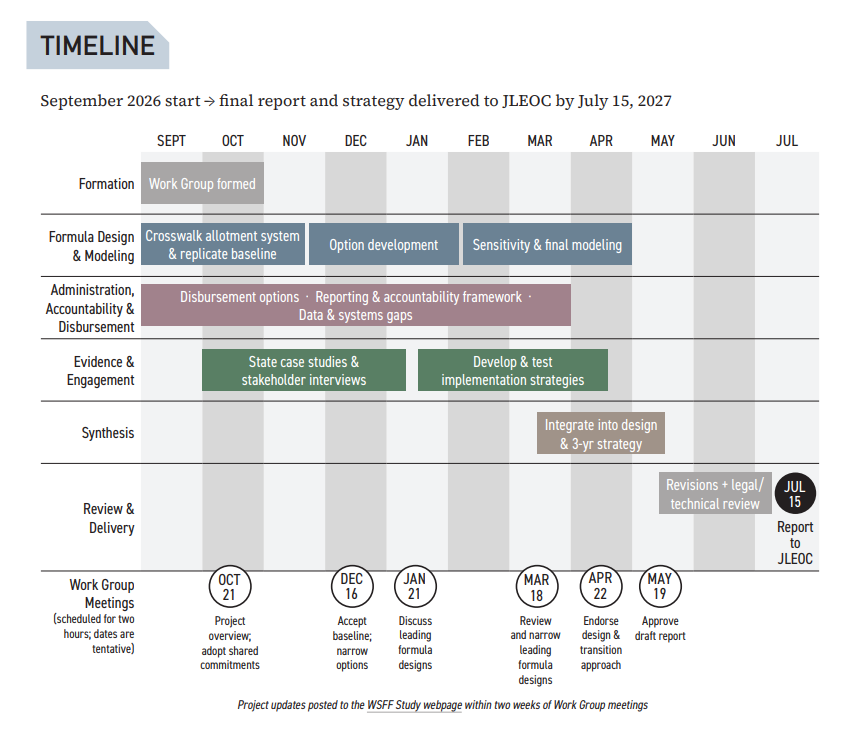
You can see the meeting dates in the timeline below.
The work group’s first meeting
The work group held its first meeting on Oct. 21, 2026, according to the press release, and a summary of the meeting has been posted.
The work group plans to meet six times between October 2026 and May 2027. The report is due to the legislature on July 15, 2027.
One-stop shop for all information on research and the work group going forward
Also this week, Basis launched this webpage, where the public will be able to track the research on the weighted student funding formula and the progress of the work group, including the meeting summaries.
The webpage notes, “This study builds on recent work by the John Locke Foundation and the Public School Forum of North Carolina, which, from different vantage points, reached the same conclusion: the current system needs significant improvement.”
Basis posted an overview of the project this week. Three workstreams, says the overview, will proceed concurrently and inform one another throughout the 10-month project:
Evidence and engagement | Conduct targeted case studies of states with weighted funding experience and structured interviews with up to 50 North Carolina stakeholders to understand implementation lessons, differing perspectives, and needs related to transition, technical assistance, communications, and accountability.
Formula design and modeling | Map the function of each existing allotment; build and validate a district and charter simulation model; test alternative formula specifications; and analyze distributional effects and transition protections.
Administration, accountability, and disbursement | Examine disbursement, financial reporting, accountability, data infrastructure, systems, staffing, and administrative capacity, with particular attention to feasibility and burden on state agencies, districts, and charter schools.
More information about the scope of work is included in the shared commitments document:
The final product will be a proposed three-year transition strategy from
the current allotment-based funding model to a weighted student funding formula model, including policy, funding, messaging, and technical assistance needed for leaders of local school administrative units and schools within those units should the state choose to pursue such a transition,.At a minimum, the study will examine options to:
a. Consolidate nonteaching support funds into a flexible per-pupil allotment with significant flexibility;
b. Transition teacher pay from a position allotment to a dollar allotment based on average daily membership, maintaining student-based funding with greater average teacher pay transparency and flexibility;
c. Reassign all project- or resource-based funding into a set of designated line items;
d. Determine whether need-based funds can be consolidated and transitioned into a per pupil figure; and
e. Report on spending and provide any other needed accountability for the use of State funds.The study will also examine whether to transfer responsibility for disbursing funds to local school administrative units from NCDPI to the State Education Assistance Authority (SEAA).
The overview includes this timline:
In the overview, you can find the 18 research questions included in the scope of work.
Interested in learning more and/or engaging with NC’s weighted student funding model research study?
If you would like to learn more or engage with the work group, here is an interest form.
Questions from legislators, the media, and others should be directed to the Collaboratory and the Basis research team.
More on the NC Collaboratory
Dr. Jeni Corn, who is well known for her research and evaluation at both the Friday Institute and DPI, is now a research director at the Collaboratory, and she says you can think of the Collaboratory as the “research and grantmaking arm of the General Assembly,” which sets its priorities. The Collaboratory is housed at UNC-Chapel Hill.
The North Carolina Collaboratory is a research funding agency that partners with academic institutions and government entities to transform research into practical information and technologies for use by the State and local governments and the communities they serve.
Since its authorization in 2016 by the General Assembly, the Collaboratory has stewarded approximately $250 million in appropriations from the legislature, investing in over 700 research projects that have the potential to develop innovative, evidence-based solutions that benefit our State and its residents.
Initially focused on environmental and natural resources research, the scope of the Collaboratory’s portfolio has expanded to include projects focused on public health, education, technology, and infrastructure.
— NC Collaboratory website
More newly created, the Collaboratory’s Office of Learning Research (OLR) was established by the legislature in December 2024.